
A biotechnology announcement can contain several impressive nouns: invention, patent, trial, approval. Placing them in one sentence can make them sound like stages of a single certificate. They are not. A patent filing concerns an asserted invention; medicine approval concerns a product evaluated for a defined use through a regulatory process.
This distinction is especially useful when reading about peptide innovation. A sequence, formulation or manufacturing approach may appear in patent material long before anyone has established that a corresponding product benefits patients. The documents need to be read for the question each actually addresses.
A patent is about an invention and defined rights
The United States Patent and Trademark Office explains that a patent grants a right to exclude others from certain activities involving the claimed invention. The USPTO’s explanation of patent rights also makes a crucial distinction: a patent is not an affirmative authorization to make, use or sell an invention.
For a reader, that means “patented” cannot be translated into “approved medicine.” It also means that a patent’s title is not a reliable substitute for reading its claims and status. A broad-sounding title may sit above a much more specific set of claims.
A filing is another distinct milestone. Someone submitting an application does not mean an examining authority has granted every claim as submitted. When taking notes, preserve the document’s actual status rather than treating application, publication and grant as interchangeable words.
Medicine approval asks a different set of questions
The FDA’s overview of drug development and approval describes review of evidence concerning a medicine’s safety and effectiveness, together with other product information. The review concerns a particular product and proposed use, not an unlimited endorsement of every application of its scientific idea.
A useful reading habit is to keep the intended population, condition and product attached to an approval statement. Removing those qualifiers can turn a bounded conclusion into a much broader claim than the evidence supports.
Approval also does not mean that a medicine has no risks. Benefit and risk are evaluated in a defined context. A patent record, by contrast, does not perform that clinical assessment simply because it mentions a health-related purpose.
Draw parallel tracks rather than one ladder
A single ladder encourages a misleading story: discovery leads to patent, which leads to proof, which leads to approval. Real development questions are less tidy. Legal, scientific, manufacturing and clinical work can proceed in parallel, stop, change direction or concern different versions of a product.
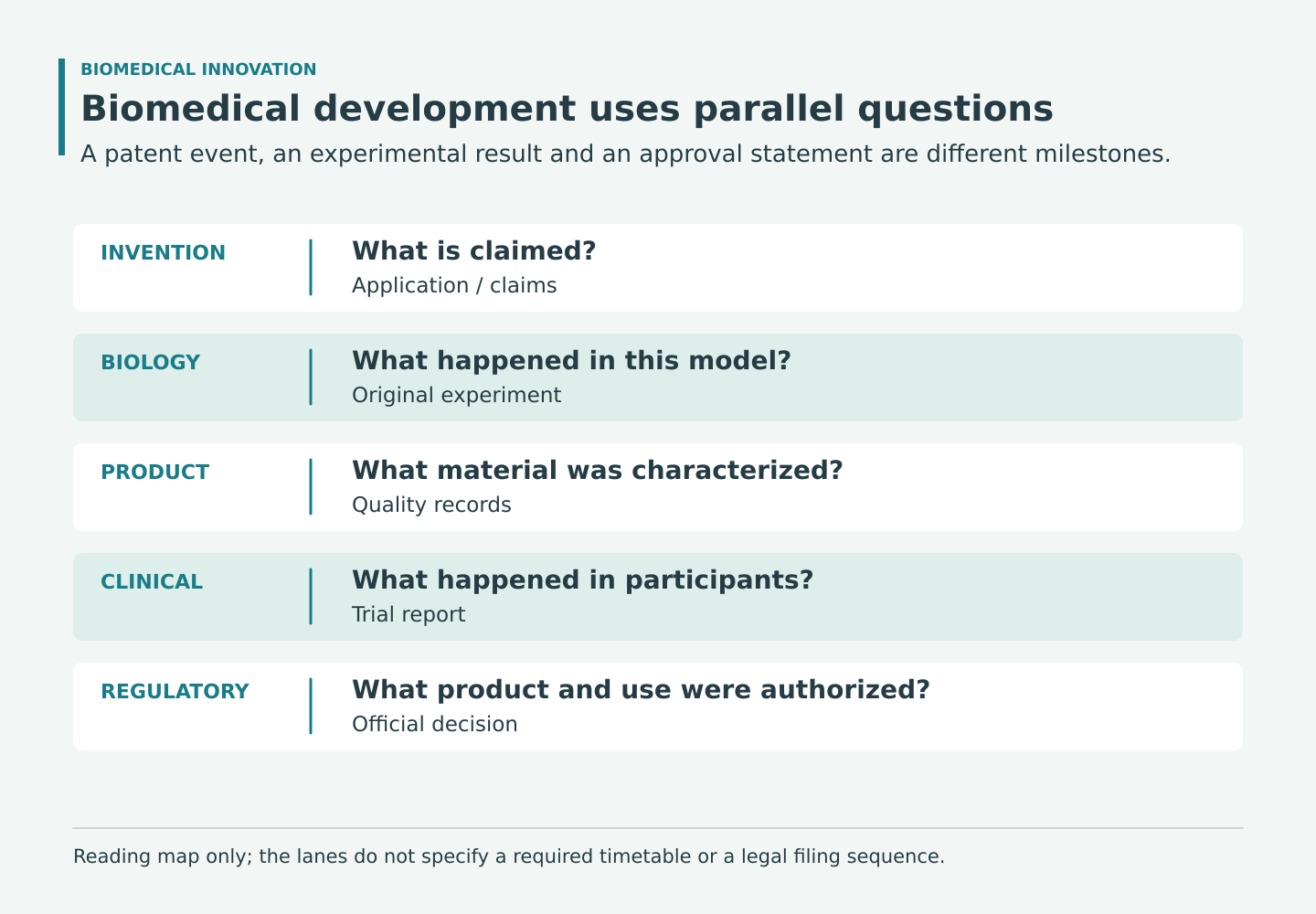
| Track | Example question | Document that might help |
|---|---|---|
| Invention | What feature is claimed as new? | Patent application and claims |
| Experimental biology | What did the peptide do in this model? | Original research paper |
| Product quality | How is the defined product characterized? | Manufacturing and analytical documentation |
| Clinical evaluation | What happened in the studied participants? | Trial report |
| Regulatory status | What product and use were authorized? | Official regulatory record |
The table is a reading aid, not a filing checklist. Each row supplies a different kind of information. An answer in one row can inform another without replacing it.
A fictional announcement, unpacked
Imagine a company called Example Research announces that it has filed a patent application for a peptide coating. Its laboratory report describes improved attachment of cultured cells to a surface. A separate sentence says the approach could eventually support tissue repair.
Three claims are present. The filing is a legal-development event. Cell attachment is an experimental observation. Tissue repair is a proposed application. Combining them into “patented peptide repairs human tissue” changes both the development status and the level of evidence.
A more accurate summary would preserve the separate clauses: the company reports a filing, an experiment measured cell attachment, and a possible medical application remains a future question. Nothing is lost by making the boundaries visible; the actual innovation becomes easier to assess.
Keep the version of the invention in view
A research program may change its sequence, carrier, formulation or manufacturing route as it develops. A familiar project nickname can persist even when the object under study changes. That is why a document date and a precise product description matter.
Consider a hypothetical sequence called P-17. A later paper studies P-17 attached to a polymer, while a third paper evaluates a tablet containing a modified version. These are related projects, but they are not automatically the same experimental object. A patent mentioning one version cannot settle the performance of every later version.
In a notebook, give each version its own line. Record the modification and the source that defines it. This avoids a common reading error: combining the most favorable feature from several different constructs into one imaginary product.
What a patent can still teach a curious reader
Patent documents can be useful sources of technical ideas, terminology and development history. They may describe a problem, propose a solution and provide examples. The right response is neither to treat them as clinical proof nor to dismiss them as scientifically empty.
Instead, ask what kind of material you are reading. Is a paragraph describing an experiment, a proposed embodiment or a claimed scope? Those categories can appear close together on the page while serving different purposes.
A reader who only wants to understand the biology can extract a question for further research: which modification was proposed, what obstacle was it meant to address, and where has that modification been tested? This converts a complicated legal document into a useful scientific lead without overstating its authority.
A compact reading note
Write five fields beside an innovation announcement: document type, date, exact subject, demonstrated result and unresolved question. Add status only when an official record establishes it. If the announcement mentions approval, record the product and use rather than writing “the peptide is approved” without context.
The result is a clearer picture of development. Patent activity can show that an invention is being pursued. Research can show how it behaves in a specified system. Regulatory review can establish a product’s authorized context. Keeping those statements separate is essential to understanding biomedical innovation.